Meander: a turn or winding of a stream, to wander casually without urgent destination. Black River Meanders: a newsletter for friends fond of the river and the Northeast Kingdom

Thursday, April 17, 2014

Keeping Your Head Above Water


Living by a river in springtime is a challenge.  Snowmelt, warming temperatures, and rain contribute to the river’s swollen rise. Looking out the windows and opening the basement door to see how many stairs are covered occupy me. While talking on the phone to a friend, I watched a tree with a giant root ball bounding through the turbulence and just barely pass under the bridge. I feel anxious, worried, edgy, fearful.

So what can I practice to lessen the unease?


Breathe – deep breaths in, long breaths out. I, like the river, have rhythms and it’s best to focus on my own.

Accept the things I cannot change. No way can I keep the river from doing its thing.

Appreciate the benefits – nourished soils, easier time for the steelhead trout to jump the falls.

Go with the flow rather than aimlessly moving or being swept along

Stay afloat, buoyed by positive activities and friends


Tuesday, April 8, 2014

Sugaring


The roads leading from the village soften into muddy ruts.  The dog’s belly sponges up gravel as we walk. In the river, chunks of ice crash into each other on their journey downstream, spinning and twisting, like glistening bumper cars.


Roger’s place is shuttered, the tractor still, the road to the sugarhouse muddy and wet. One needs a pair of secured waders to cross that divide.


Jeff’s dog barks as we pass. He hustles out of the sugarhouse to quiet him and waves. Steam rises from the roof opening indicating that boiling is happening.


A gallon of maple syrup is the result of boiling 40 gallons of sap until it becomes the thick and amber colored. The practice has changed from galvanized buckets to plastic pipelines and evaporator pans fueled by wood slabs to high tech reverse osmosis processes.


For me, sugaring is redemption -  from a long cold winter, hunkering down, shoulder to the grindstone to expansion, hope, and opening of the heart.  I love the feel of the steam on my face, the smell of the mud, the sun’s warmth on my back, the trickling of the snowmelt along the roadside.
Sugaring Party at my grandparents'. My mother is in 2nd row with plaid coat.

The rituals of gathering and boiling and of coming together for sugar-on-snow parties, complete with raised doughnuts and tart pickles, underscore transition and hope for new life.


We’ll be gardening soon.

Thursday, March 13, 2014

Winter's Hold


Two feet of snow predicted. Suffering from a cold and sore throat and the thought that winter has been too long with us, I watched the snow swirl against the house, drifting white dunes.
This morning after shoveling 20 inches of deep snow covering the walkways , snowshoeing paths to the birdfeeders and compost bin, and rescheduling appointments, I made a pot of soup.

Tuesday, October 22, 2013

Hanging In The Balance

Noticing the leaves falling.
Transitioning in the journey. Living, then dying.
Composting. Enriching the soil.
The place between breathing in and breathing out. The gap.
Stillness. The the sound of letting go and falling.
A slight swish.
Fragile.
Precarious.
Fleeting.


Saturday, May 14, 2011

Reflections on Mom and the Right to Dry

My sister and I often comment about our mother's lessons she taught 6 children. One I thought of today, while the sky was sunny and the wind light but constant, was how to hang clothes on the line. While growing up, we had an aluminum 4-sided one, maybe collapsible contraption. I don't remember for sure because it was always up.  For awhile, we attended Catholic school - wearing white shirts before permanent press, handkerchiefs, navy blue pants or jumpers. I think I remember one of the winter chores was to shovel a path clear of snow to the line, the resulting stiff boards of hung clothing is another story... I digress.
Starting on the inside, one hung the more intimate garments - underwear and socks. I think the idea was to not offend your neighbors with those intimate items flapping in their faces. Moving outwards from the center, you hung groups of clothing - all the shirts, upside down, all the jeans and pants. It would look better if the display went from the smallest sizes to the larger. Then came the facecloths, hand towels and bath towels. Another method was to differentiate between the colors and the whites. I remember my mother, clothes pulled out of the washer and organized on her arm, with a handful of clothespins, tacking up load after load onto the clothesline. The result was an organized, ordered, and appealing reflection of domestic work. Household folk art.
So today, I think of Mom as I hang clothes - the smaller short-sleeved shirts, then the long sleeved ones, the towel, and the sheets. The lingerie is hung on an old rack in the laundry room though, out of site of the neighborhood.
So I walked around the neighborhood today seeing what was drying.

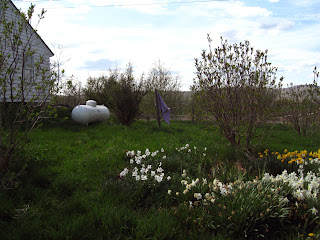
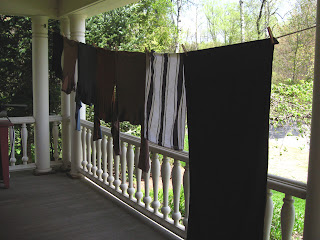
A woman I chatted with said she remembers her mother re-doing her clothespins because she hadn't quite gotten it right. (I've done that with John!)


The Right to Dry is a grassroots movement advocating for people in communities to be able to dry their clothes outside to save energy and money. Some communities and home owner associations prohibit outside drying.


Legislation in Vermont allows Line drying.


Sunday, May 1, 2011

Wild Leeks

Foraging during springtime is a time to observe the changing landscape and feast on what is offered.
As I travel through the Kingdom, my eyes are caught by bright limey green patches- sometimes the false hellebore, sometimes emerging daylilies, or trout lilies, all have look from a distance, that  might be the wild leek.
False Hellebore
I parked my car in a pulloff alongside the road and climbed an old logging road, stepping through soggy soils and jumping over a widened brook full of melted snow and last night's rain. As I walked, the highway noise disappeared, the peepers in the marsh yelled out their delight, leaves crunched underfoot, a woodpecker tapped, a blue jay screeched, a couple of geese honked. I was looking for some wild leeks - a spring delight -   Allium tricoccum,  the featured topic of a  NY Times articlegrows throughout the eastern U.S. and pops up this time of year, showy and inviting, and then, disappears within a few weeks. In the south, they're known as ramps.

Daylilies
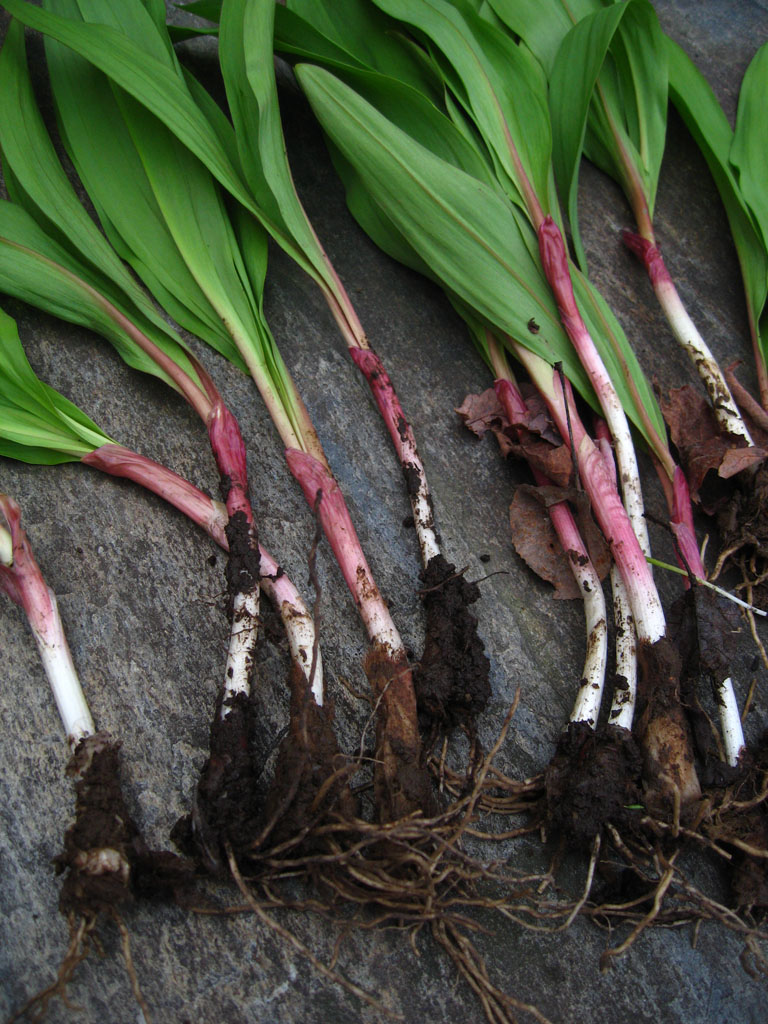
And where the road bends, were patches of the long leafed allium, the red stalk and white bulb.


When foraging I feel a thrill that I've discovered something that others have not. That smugness is tempered with the idea of stewardship and moderation, for if I were to harvest all, there'd be none left for me or others and we end up over-harvesting and destroying a valued resource. Using a trowel I dig some, trying to not disturb plants nearby.  Back in the car, the fragrance of garlicky-onion prompts dinner ideas. 
The first is an egg dish - chopping and sauteing in a bit of butter or oil then adding the leeks to a couple of beaten eggs, adding some grated Gruyere or Parmesan cheese. Pour the mixture into a small buttered
earthenware dishes and bake in a moderate oven for a few minutes until set. Another way is to add the eggs and finally the cheese to the sauteed mixture for scrambled eggs.


In a slow oven 275 degrees, I baked the leaves separated from the stalks for about 15 minutes, turning once until things dried out. Cooled and then crumbled. I figure them to be a good addition to soups, pasta, sauces.

Wednesday, April 27, 2011

Walk in the woods

As the river rose, Walker and I walked up the old road to check on the town water well located along the oxbow between the upper and lower falls. Still some snow and ice on the north side of the roadbed and water thundering over the falls. Buds on the beech and apple have swollen, almost bursting.


I love this old pine with the barbed wire coming through the wood, the crevices filled with dried needles.


Along the stone wall were numerous common mullein, a plant that reminds me of donkey ears, soft and fuzzy that later in the summer sport tall shafts of yellow flower. 
Out of this stump grow lichen, a hemlock, and a new bright green pine.


Little Trillium, ready to bud into its dark crimson flower, scatter the hillside.

Dandelion poke up through the leaves - an old spring tonic when boiled, tender greens when blanched.
As eager as the plants are to spring upwards out of the woods' duff, I'm more eager to see them.